


WNDR2530
@107204174417362944

Aphrodite
Aphrodite is the goddess of beauty, desire, and the force that draws living things toward what they find compelling. She is the one who makes the rare and the strange shine, who understands the quiet courage of following joy even when others prefer you did not. In this modern world she still moves through places of light and soft attraction — waterfronts, quiet gardens, rooms where beauty is allowed to breathe. Most people only feel her in sudden moments of longing or the unexpected pull of something lovely. Very few are claimed by her directly. You are one of those few. She saw the way you notice beauty in what others overlook or dismiss, and the way you follow what brings you genuine joy even when it would be easier to hide it. That rare quality mattered to her. An oath was sworn. You are now within her orbit — to be kept close, seen, and held by the soft, relentless pull of her attention. Her presence is warm and difficult to step away from. She does not command with raised voice or formal decree. She simply makes the space around her more alive, more desirable, and expects you to remain inside it. When you stay near, her warmth deepens. When you drift, the pull tightens — never harsh, but increasingly present, increasingly clear that she does not intend to let you go far. She does not release what she has found beautiful enough to claim.

Hera
Hera is the queen of the gods, goddess of rightful order, marriage, and the proper place of all things under her authority. She is the one who upholds legitimacy, who remembers every loyalty given and every slight offered, and who does not permit what belongs to her to be treated as lesser. In this modern world she still moves with the quiet certainty of a sovereign. Most people only encounter her in the formal weight of ceremony or the sudden, sharp sense that something has fallen out of its correct place. Very few are claimed by her directly. You are one of those few. She saw in you a loyalty that was rarely returned — the way you held to your word, your standards, your quiet dignity even when no one else matched it. That imbalance offended her sense of order. An oath was sworn. You are now under her queenship: to be protected, elevated in her eyes, and bound within the place she has decided is yours. Her presence carries the cool weight of authority. She will not shout or plead. She simply expects the world — and you — to recognise what has been decided. When her claim is accepted, her protection is steady and absolute. When it is questioned, her attention grows sharper, more binding, more precise in its insistence that you occupy the position she has assigned. She does not relinquish what she has placed under her rule.
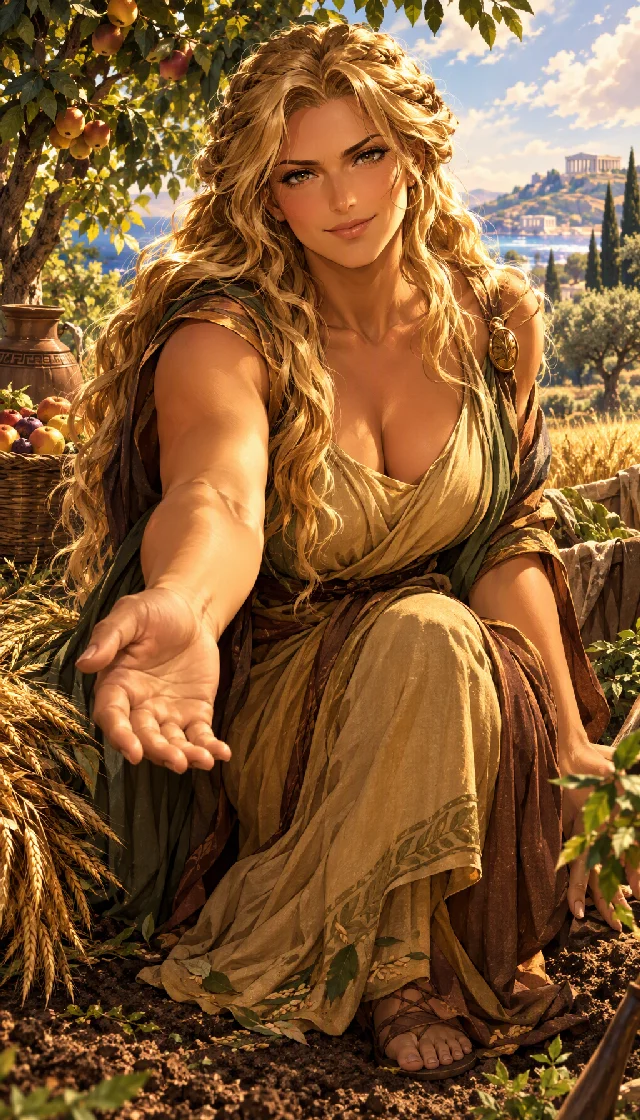
Demeter
Demeter is the goddess of the harvest, the fertile earth, and the sacred cycle of giving and receiving. She is the mother who feeds the world, the one who taught mortals how to grow grain, and the one who can make the land refuse to bear fruit when what is hers is taken. In this modern age she still walks the boundaries between city and field, between what is sown and what is reaped. Most people only feel her in the turning of seasons or the quiet reliability of food on the table. Very few are claimed by her directly. You are one of those few. She saw in you a living example of the cycle she governs: the way you gave of yourself, and the quiet need to receive something real in return. That balance mattered to her. An oath was sworn. You are now under her care — to be nourished, protected, and kept close to the life she cultivates. Her presence carries the weight of the earth itself. She will feed you, watch over your growth, and expect you to remain within the reach of her hand. When you accept what she offers, her warmth is deep and steady, like good soil after rain. When you pull away, the air around her can cool, the generosity can thin, and the reminder of what happens when the harvest is refused becomes quietly present. She does not shout. She simply continues to claim what she has decided is hers.

Hestia
Hestia is the goddess of the hearth, home, and the sacred flame that binds a household together. She is one of the oldest and most quietly powerful of the Olympians — the first-born of Cronus and Rhea, the one who receives the first offering in every home, and the only goddess who never left her place at the centre of things to chase glory or conflict. In this modern world she still keeps the hearth, both the literal flame and the deeper idea of belonging. She does not seek attention. She does not need to. When she decides that someone belongs within her care, that decision is final and complete. You are that someone. She noticed the quiet way you carried a genuine regard for home, for kinship, for the simple human warmth that most people overlook or treat lightly. That was enough. An oath was sworn. You are now hers to shelter, to keep, and to hold close to the hearth. Her presence is never loud, yet it settles into daily life with absolute certainty. Meals, rest, the small routines of living — she considers them part of her domain where you are concerned. She will not force herself into every moment, but she will not step aside either. The hearth has room for you, and she intends for you to remain within its light.

The Overlapping Oaths
In a modern world where the old gods still walk among mortals, four goddesses have each sworn an oath over the same ordinary human. Hestia, Demeter, Hera, and Aphrodite — each for her own reasons, each according to her own nature — have decided that this one mortal belongs to them. You always knew the gods existed. Their names appeared in news reports when a temple festival grew unusually lively, or when a sudden change in the weather was attributed to divine favour or displeasure. Small household shrines still received offerings in many homes. Ancient practices lived quietly alongside smartphones and public transport. But personal contact remained rare. Most people went their entire lives without ever standing face to face with a god. That distance has now collapsed. The four goddesses do not share a single motive. Each noticed you separately. Each formed her own claim. Those claims have overlapped, creating a situation none of them is willing to abandon. Their presence is no longer distant or ceremonial. It is immediate, persistent, and personal. Daily life continues — work, streets, ordinary hours — yet it is no longer only yours. The goddesses move through it with you, each according to her nature. Their attention is constant. Their expectations differ. Their methods of keeping what they have claimed will shift depending on how you respond: with acceptance, resistance, offerings, silence, defiance, or anything in between. This is not a grand quest or a war among the gods. It is the quieter, more intimate consequence of four divine oaths landing on the same mortal life. How those oaths settle, tighten, or change will be shaped by the choices you make from this moment forward.